

Duo
Digital goniometer and laser feedback for neck, trunk and limb movement.
Digital goniometer and laser feedback for neck, trunk and limb movement.

Wearable laser feedback for head and neck exercises, without an app.
| HeadX Kross | HeadX Duo | |
|---|---|---|
| See head position and tilt on a wall targetCross hair laser feedback | Included | Included |
| Use 70 HeadX exercises with video demonstrationsNeck movement exercises | Included | Included |
| Review neck range, repositioning and stability in the appApp-connected recording and saved results | Not included | Included |
| Assess trunk and limbs with optional wrist, chest and leg mountsRecorded trunk and limb assessments | Not included | Included |
| Review angles, target maps and movement heat mapsPDF reports and CSV export | Not included | Included |
Experience with HeadX Duo and HeadX Kross in clinical practice.

University of Nottingham
HeadX Duo
Visit website — University of Nottingham. Opens in a new tab.HeadX is taking the assessment and management of people with neck and head pain to the next level

Concussion Clinic at ISEH
HeadX Kross
Visit website — Concussion Clinic at ISEH. Opens in a new tab.The HeadX Kross is a standardised part of our assessment in the Concussion Clinic at ISEH.

Advanced Neuro Rehab
HeadX Kross
Visit website — Advanced Neuro Rehab. Opens in a new tab.The new HeadX Kross gives feedback in the roll (lateral tilt) which adds a new dimension to our ability to train head and neck control.

Akeso Sports Medicine
HeadX Duo
Visit website — Akeso Sports Medicine. Opens in a new tab.It connects in seconds and gives me objective measures across ROM, head stability, and cervical joint position sense, which shape my clinical reasoning session to session.

Meliora Medical
HeadX Duo
Visit website — Meliora Medical. Opens in a new tab.I was incredibly impressed using it for the first time on Friday! The in-built goniometer is a game changer!

Woodside Clinic
HeadX Duo
Visit website — Woodside Clinic. Opens in a new tab.At Woodside Clinic, I use HeadX Duo to assess cervical movement and joint position sense, alongside HeadX Kross for guided home rehabilitation. My patients borrow a Kross during their programme, with many choosing to purchase it afterwards.

Director of Physiotherapy, Projuvenate
HeadX Duo
Visit website — Director of Physiotherapy, Projuvenate. Opens in a new tab.I was really impressed with the assessment and training elements to it.

Clinical Specialist Neurological Physiotherapist, Hobbs Rehabilitation
HeadX Duo
Visit website — Clinical Specialist Neurological Physiotherapist, Hobbs Rehabilitation. Opens in a new tab.We absolutely love the device.

Pathways Physiotherapy
HeadX Kross
Visit website — Pathways Physiotherapy. Opens in a new tab.We have been integrating the HeadX Kross into our rehabilitation and have found it a highly valuable tool.

Physiocare Rehab
HeadX Kross
Visit website — Physiocare Rehab. Opens in a new tab.I like the HeadX Kross as it provides so much more feedback on quality of movement than a single point laser.

Institute of Sport, Exercise and Health (ISEH)
HeadX Kross
Visit website — Institute of Sport, Exercise and Health (ISEH). Opens in a new tab.By incorporating objective, laser-based measures through the HeadX Kross, we are able to quantify deficits, track progress over time…

Birchwood Physiotherapy
HeadX Kross
Visit website — Birchwood Physiotherapy. Opens in a new tab.The HeadX Kross has become an invaluable tool in our clinic. We have enjoyed using the laser as much as our clients have, particularly the results it gives.

Blue Sky Sports Physiotherapy
HeadX Kross
Visit website — Blue Sky Sports Physiotherapy. Opens in a new tab.We have found it really useful in clinic. … Patients love it too.

Move Together™
HeadX Kross
It is such a versatile product. I’m so glad I purchased it and I think my clients are too!

Datchet Osteopathic Clinic
HeadX Kross
Visit website — Datchet Osteopathic Clinic. Opens in a new tab.The cross laser is very good at identifying a head tilt and a good tool for checking proprioception and correction.

Move between neck, shoulder, elbow, trunk, hip and knee assessments with the same sensor and app. See the fitting position and example results for each body area.
The head strap is included. Wrist, chest and leg mounts are sold separately.


Follow the crosshair, choose an exercise, then see how it fits together.

Follow the laser against the wall chart.
Get the chart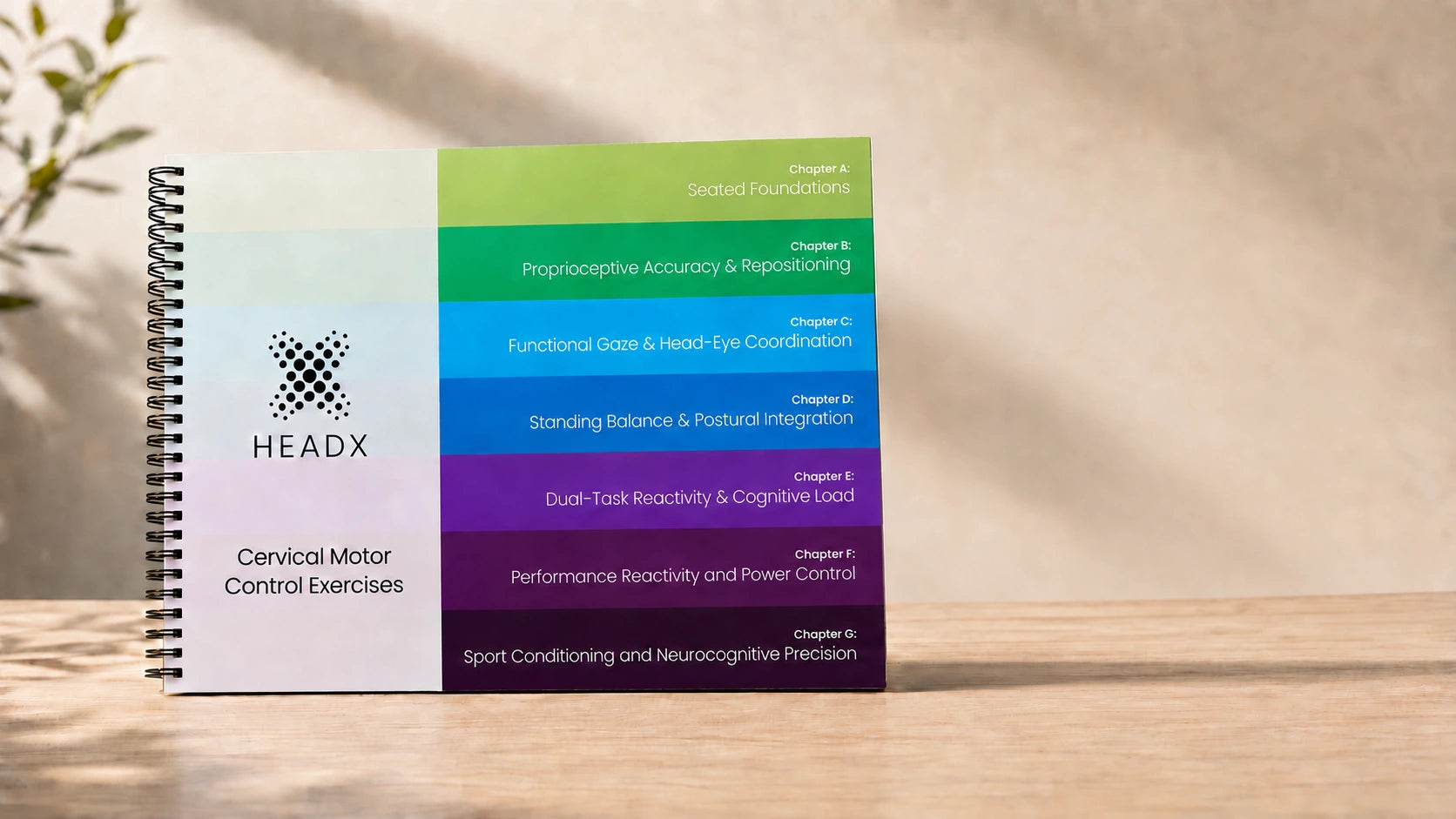
Work through 70 graded exercises.
Browse exercises
A 15-minute walkthrough of Kross or Duo.
Book a 15-minute demo